
Last week, streaming platform Deezer announced that more than 50% of all new tracks released in June 2026 are generative AI music.
“It’s evident that the primary purpose of uploading these tracks to streaming platforms is fraudulent,” the announcement continued. “Deezer has found that up to 85% of the streams generated by fully AI-generated tracks were in fact fraudulent in 2025.”
Unlike other streaming platforms, Deezer has been upfront about these figures as they develop, and about its efforts to counter the rising tide of slop. The company is already identifying and tagging generative AI tracks, and removing those it determines are fraudulent. As a result, Deezer offers the reassurance that, “fully AI-generated music accounts for only a small fraction of listening activity, between 1 and 3% of total streams.”
If 1-3% of total streams sounds inconsequential to you, consider that in 2023, during her Eras tour, Taylor Swift’s streaming volume broke all records by reaching 1.7% of total streams. Generative AI music tracks are already pulling the equivalent or more than Taylor Swift at her most media-saturated moment. And the figure is only going to increase: a study commissioned by the International Confederation of Societies of Authors and Composers (CISAC) and cited by Deezer predicts that, “By 2028, Gen AI music will account for around 20% of music streaming platforms’ revenues.” For comparison, Apple Music and Amazon Music together accounted for 21% of music streaming in 2025.
So is generative AI fraud really a “small fraction of listening activity,” as Deezer put it? Or a tsunami of shit already as big as Taylor Swift and soon to be as big as all the streaming on Apple and Amazon combined? Figures shared by Deezer indicate the latter.
How this effects human musicians is the issue I want to focus on. No doubt this is because I am a human musician.
One of my favorite music business journalists, Ben Sisario, recently published an explainer about AI music in the New York Times. It is aimed at consumers, and manages to be clear (and clear-eyed) about some tangled issues that are rarely presented straightforwardly to creators.
Here he is on the issue of fraud: “Under the financial pools used in streaming, the online platforms pay proportionate fees to the companies that provide content, meaning everything paid to bogus creators reduces what’s left for real artists.”
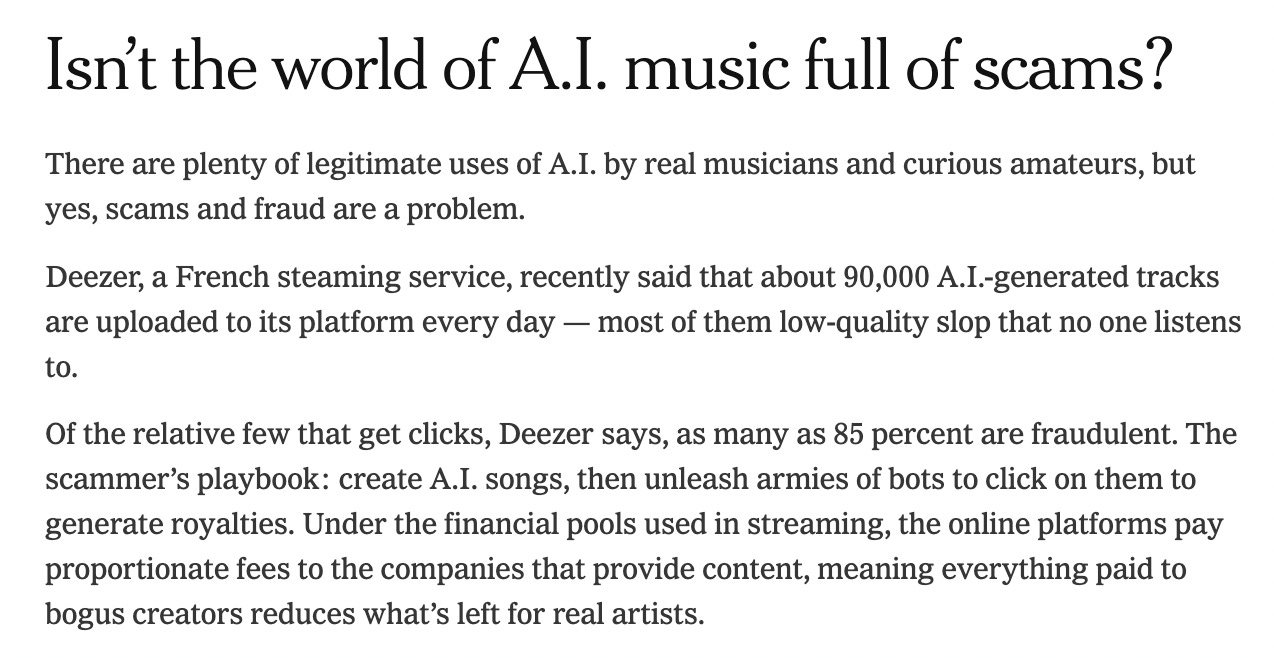
This is a fact that Sisario presents without any hemming and hawing: fraud from AI music on streaming platforms dilutes the royalty pool for “real artists,” that is, human musicians. The more money directed to generative AI tracks, the less to living creators. Streaming is a zero-sum game because of the way that Spotify, Apple, Amazon and other streaming platforms calculate payments to rights holders. This system is known as “pro-rata” since each track is remunerated according to its relative percentage of streams in total. There is one pot; each of us has a sliver of it, from Taylor Swift on down.
An alternative to “pro-rata” accounting is known as “user-centric” - instead of sharing a percentage of the total pot, each is paid according to their listeners’ contribution to the pot. That is, if you stream nothing but Cocteau Twins, your subscription money (or the earnings from the ads you view while you stream for free) goes to the Cocteau Twins. Not to Taylor Swift, and not to fraudsters.
You might think these two systems would work out the same - but they don’t. Pro-rata rewards more to those who game the system: if you can find a way to generate more streams than your fans pay in, you win more of a share of everyone’s total royalties. If you don’t, you lose share according to how much the system is gamed by others.
This is the scenario artists have been facing from well before generative AI tracks entered the streaming market. Five years ago, I wrote about the effect of streaming fraud through click farms and how it shrinks the pro-rata payout for artists who don’t participate in such things. Spotify’s pay-to-play services (known by the company as marketing programs and by the rest of us as payola) are another way that pro-rata accounting can be skewed to pull money away from those who contribute only music and their fans’ listening time. So is Spotify’s demonetizing of all tracks with fewer than 1,000 streams a year, a diversion of funds paid by listeners to 88% of the tracks on the platform to those who upload the remaining 12%.
AI supercharges the existing scenario for streaming fraud rewarded by pro-rata accounting. If you are listening to nothing but Cocteau Twins today, your subscription dollars are not only paying Taylor Swift for the privilege but also generative AI uploaders.
This points to a simple solution for the chaos introduced by generative AI music: Pay human artists fairly.
Let’s imagine that streaming platforms switch to user-centric accounting. All the generative AI tracks being uploaded could not generate any more income than its specific listeners’ provide. If no one listens to this crap, it earns nothing. And much of the incentive for uploading it disappears.
What’s more, all we human artists would earn the same regardless of how much generative AI music is uploaded. If we are paid according to our specific listeners’ time spent with our tracks, we gain nothing and lose nothing from the sea of generative AI our listeners ignore.
Slop problem ameliorated, if not solved? For those who do not benefit from gaming the system, yes. And yet none of the powerful players involved seem to be pushing this solution.
To understand why, let’s take a look at those who do benefit from streaming fraud - starting with the platforms themselves.
Like any platform capital business, streaming is directed at scale and therefore its primary goal is volume. Spotify, same as Amazon in its original form, lost money for years while building up market share - its only path toward viability was numbers, numbers, and more numbers. Streaming fraud has been tolerated if not encouraged by Spotify from the get-go because it contributes to volume. As I wrote about platforms and streaming fraud back in 2021,
The mechanism by which they benefit is easy to understand: for Spotify, inflated streaming numbers means inflated market share, which ultimately means real cash.
Market capital is how Spotify makes big money. Long before Spotify could turn even a marginal quarterly profit, its owners made billions from capital and its executives were among the highest paid in the music industry.
But platforms aren’t the only ones in music to benefit from volume regardless of legitimacy, and generative AI is making this more obvious than ever. To take Spotify as the dominant model again, tracks can only be uploaded to it from a list of approved distributors, each of which, as the platform explains, “charge a fee or commission.” Distribution, needless to say, is also a volume business - not through the mumbo jumbo magic of capital markets, but the old-fashioned accumulation of transactions. Generative AI music benefits distributors; it has already done so by increasing uploads to platforms by more than 50%.
You might think that record labels would be losers in these volume-chasing businesses that profit from fraud. And for many independents, you would be right. But for the majors, not so much because Spotify itself and a number of the distributors with exclusive access to Spotify are owned or part-owned by major labels or private equity tied into a web of shared financial interests. Universal’s recent purchase of CD Baby is just the latest in a long line of such mergers and acquisitions that put the majors on both sides of the equation. So is their recent settlement with generative AI music companies for a piece of that action.
What we’re facing in streaming is a system that profits from volume regardless of legitimacy. The arguments over the legitimacy of AI music are, for this reason, something of a red herring: it doesn’t really matter to those who profit from the increased volume of tracks generated by AI whether it is “legal” or “good” or “fair” or whatever. It is more, and a lot of moneyed interests will make more as a result.
That’s fucked up from a human musician’s point of view.
There is a simple solution: use proceeds from this system to pay artists. Platforms should switch to user-centric accounting so those who listen to human artists pay those same human artists accordingly. And Congress should pass the Living Wage for Musicians Act so that not only rights holders - i.e., the major labels and distributors who have gamed this system - but human artists themselves are paid directly by platforms for their listeners’ streams.
Is that so complicated?
Listening to: Sem Fronteiras by Bruno Berle
Cooking: ratatouille
YES YES YES
Makes perfect sense to me! (Really.) What's interesting is that this problem seems to be different than the "war" raging here on Substack over "AI slop" and Pangram. Or is it? (Maybe just a different side of the same coin?)
There's one big difference, at least: AI can be pretty good at writing. But AI is pathetically bad at creating music. All it can do is crank out the same generic pop schlock with prompts like "Make me a song about losing my girlfriend." It's got a LONG way to go before it becomes a viable compositional tool used by trained musicians.
And (slightly off-topic) it speaks VOLUMES about the current state of pop music that when AI-generated tracks came along, few listeners noticed much difference between those and human-generated tracks. This makes me very sad...