
The Struggle Continues
Molly Crabapple's book of history
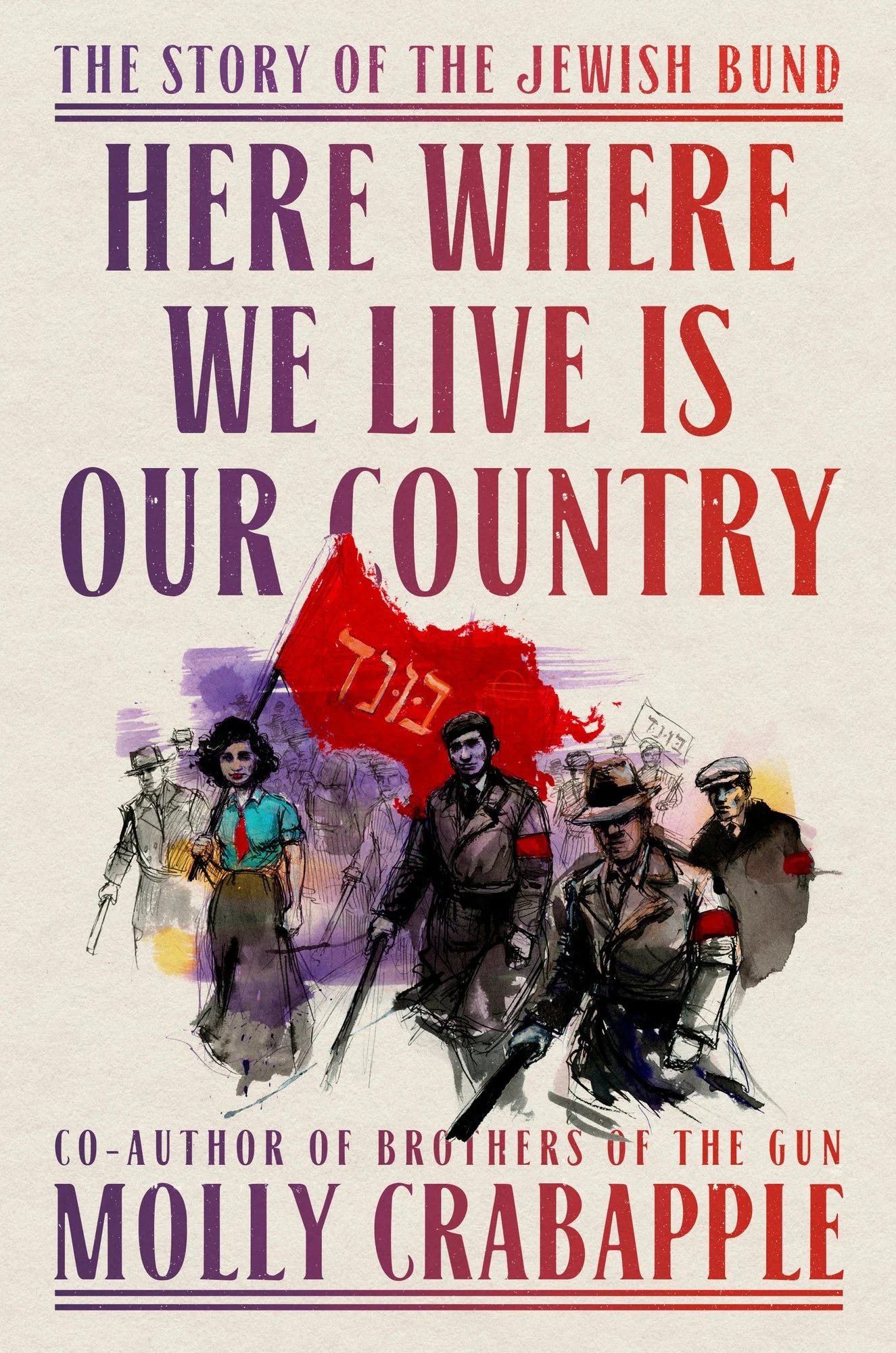
“Okay, they were right,” one friend told me after he finished my manuscript. “Right and dead. What’s the big lesson you want us to take away from that? After all, the Bund failed.”
“Lost,” I answered, more sharply than I meant.
“What’s the difference between failed and lost?” he responded.
“Failure is what happens to those overcome by their own faults and errors. To lose is to succumb to greater force.”
- from the Postscript to Here Where We Live Is Our Country
Molly Crabapple has written a new book of history that reads like a novel, not a clever postmodern novel but a massive, immersive nineteenth-century novel with long lists of characters and a sweep of time. It’s War and Peace for Jewish socialists. There is romance, there is art, there are tears, there are politics, there are wars, there are lots and lots of losing battles and a few victories. I could not put it down, staying up nights to read until I couldn’t any longer. I was sorry when the book was over, although I did not know if I could put up with any more heartbreak. Except we live this heartbreak every day, as we wake up to the news. The struggle continues.
Yes, I took this book very personally. And I am clearly far from alone in that – it is an unlikely and unexpected bestseller, the publisher is having trouble keeping it in stock. As I write this, you may not be able to locate a physical copy. Crabapple is providing some of her own to collectives, while further reprints are in the works.
Timing is everything in media, as any musician or artist knows. Crabapple worked seven years on this book, the research she undertook on the socialist movement known as the Bund is immense; learning Yiddish was just a fraction of the total effort, as the story of those who lose is buried in memories and ephemeral archives. But during the seven years Crabapple was piecing this history together, fascism resurged, Gaza happened, old racist and eugenicist arguments dressed themselves as techno-futurism, and everything generally went to shit. Those opposed may not be failing, to paraphrase Crabapple, but we do seem to be losing.
What is to be done in such times, to quote a non-Bundist socialist? Crabapple’s book of history maybe only gives one answer, an unsatisfactory one to certain kinds of revolutionaries: Do the same as always. That’s the Jewish joke in this tale. Yes, the Bund did not win out against the Nazis in Poland, the Bolsheviks in Russia, the Zionists in Palestine, the capitalists in New York. But they made things better however they could by fighting oppression. That is what I take from the theme of the book expressed by the title, Here Where We Live Is Our Country – a wordy translation of a heady Yiddish abstraction, do’iykat, or “hereness.” Make things better where you are.
Is there a more beautiful, and doomed, sentiment? Beautiful because it makes the world better, always and everywhere. Doomed because wherever we are, we are surrounded by shit.
It’s shit that fuels the corporations and the corruption driving our society to financial and moral bankruptcy, and our planet to biological extinction. It’s shit that twists the law to justify discrimination, outright racism and misogyny, and genocide. It’s shit that seals borders, external and internal, to those in need. It’s shit that denies the value of education and expertise even to the point of devastation from preventable disease. It’s shit that chooses short-term personal gains over longterm societal progress.
Do we drown in this shit? We do. But do you really want to embrace that? Celebrating losers in the battle is exactly what we need right now, because we need to fight without a guarantee, and sometimes seemingly even without a prospect of victory. It’s the only way to counter the gross iniquities of our time.
Here Where We Live Is Our Country is a recuperation – an animation, truly, because it is written with so much life – of generations of losers, of those who lived and died in the same ongoing struggle for a secular, internationalist society based on socialist ideals of equality and dignity. Identifying with these characters is perhaps all too easy for those of us with family ties to the story (again, I am far from alone in that). But I would hope you don’t have to be related to the people in Crabapple’s index to feel both inspired and depressed by their stories. Read them, once you grab a freshly restocked copy, and find out.
Listening to: Body Sound by Whitney Johnson, Lia Kohl, Macie Stewart
Cooking: the first leaves of what survived the winter
This is very powerful writing on your part and encourages me to read the book. Thanks.