
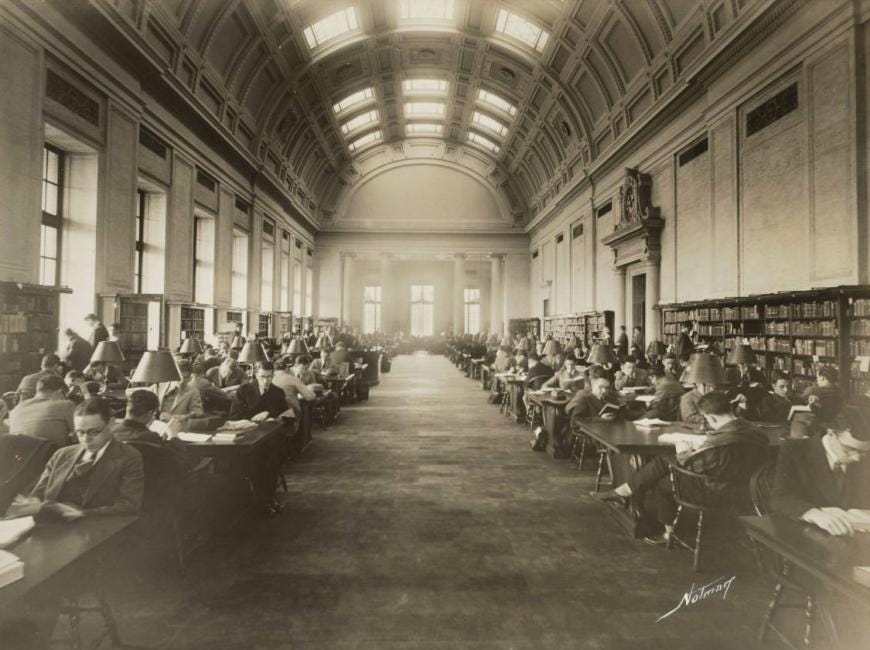
When I was in grad school, my advisor Sacvan Bercovitch explained the then-rise of “theory” in US literary studies this way: you work with what’s at hand. And should you find yourself teaching at a small college somewhere far from a large research library – as so many of his academic generation did, in wake of the expansion of higher education across the country in the 1960s and 70s - it makes sense to work with as few texts as possible. “Deconstruction,” with its emphasis on close readings of classics, could be practiced effectively at a distance from traditional centers of learning. For “theory,” most all the materials you needed could be kept on a shelf in your home.
He told me this in part, I think, to get me to make use of the massive archive I had access to at the time: Harvard Library is the largest research library in the country, and my ID got me into the stacks themselves to wander among its holdings. Widener Library, the jewel of…
