
AI is burning like a wildfire through what many of us have spent our lives constructing: for me, that’s a world of writing and music. I am far from alone in believing a machine cannot do what people do with words or sounds. But that will not stop the onslaught of machine-made versions replacing human ones in myriad ways.
What would seem to lie ahead is a loss of continuity in certain skills, as AI pulls people away from their practice. Harvard College just closed its Writing Center, to take a parochial example from down my street. Is it because the idea of undergraduates sweating over essays already seems outdated?
Or as Mikey Shulman, the CEO of AI music company Suno, has said:
“It’s not really enjoyable to make music now… It takes a lot of time, it takes a lot of practice, you need to get really good at an instrument or really good at a piece of production software. I think the majority of people don’t enjoy the majority of the time they spend making music.”
The fact that AI music is bad doesn’t seem to enter the calculation that Shulman makes about what people want from the medium. This isn’t new; AI is just the latest example, though certainly the most powerful, of what I called Murphy’s Moore’s Law in The New Analog, a book which went through many, many drafts. This excerpt is from its introductory chapter.
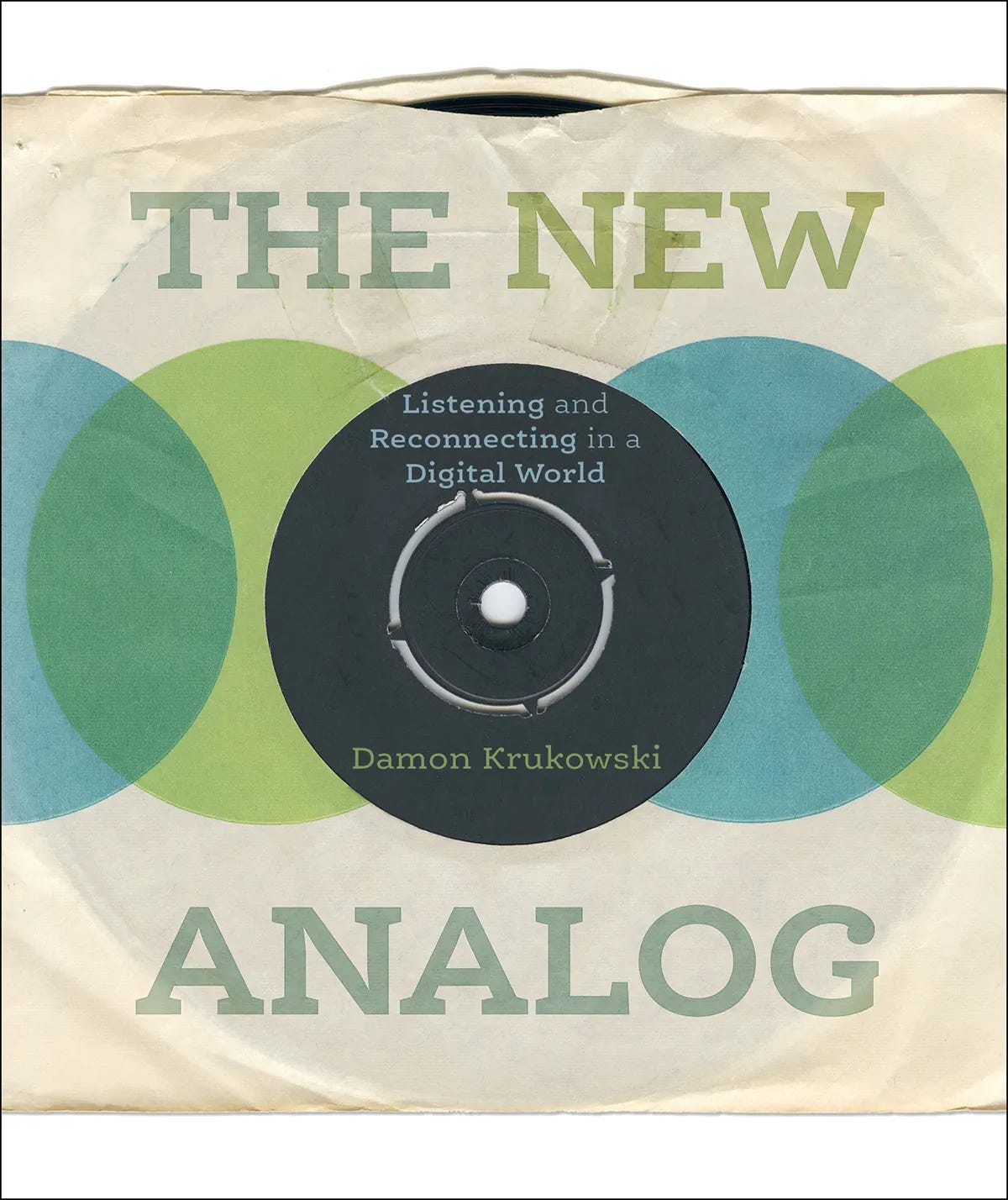
Thank you for reading this analog book. It requires no additional hardware, uses no power, and is 100 percent recyclable.
You will find that it is possible to read, or not read, any of this book’s pages in any sequence. While its pages have been numbered sequentially to assist in navigation, there is no reason to consult these numbers if you do not wish. Should you like to highlight a passage, you will find that you can mark the page with most any implement at hand — even a fingernail will do. The paper of this book is also soft enough to be folded, torn, even shredded if that gives you satisfaction, without special tools.
You are free to share this book, resell it, or donate it to charity.
The author and publisher of this book do not have any information about you; they do not even know that you have a copy of this book unless they sent it to you personally. And if they did — send it to you personally, that is — you can always pretend to have read the book without having done so. You can also deny having read it, should that prove expedient. It’s your business, really.
Welcome to the world of analog books!
*
Moore Meets Murphy
The oft-cited Moore’s Law refers to the rapid development of integrated circuits since the 1960s — and therefore to computers and digital equipment generally — which follow a pattern of doubling in power and capacity every eighteen months.
But there’s an overlooked corollary to this, which we might call Murphy’s Moore’s Law: if aspects of a given technology functioned better before the introduction of integrated circuits, they must be getting worse at the same fantastic rate. Twice as bad, every eighteen months…
Consider the typography of this book. In 1965, when Gordon Moore first formulated his observations about the rapid development of solid-state electronics, books were set in hot-metal type; that is, their words were cast into lead, resulting in crisp, detailed impressions on paper. What’s more, the technology for hot-metal typography had at that point been refined by so many generations of designers and typesetters that even an inexpensive, commercially produced book like this would bear many marks of typographic excellence accumulated over time.
A few years later — while Moore was extending his law of growth to personal wealth by cofounding the semiconductor manufacturer Intel — electronics began to make phototypesetting more cost-efficient than hot metal. Phototypesetting (or “cold type”) was by comparison prone to distortion and breaks in letter forms, and limited in its ability to use the full range of delicate typefaces that had been designed over centuries for lead. But since it utilized electronics, the cost of cold type went down while its capacity rapidly increased, just as Moore observed. Over the centuries, hot-metal innovations had accrued at a speed somewhat closer to the flow of molten lead.
This is where Murphy comes in. Since cold type was in many respects lower in quality than what preceded it, increasing its availability could only lead to more and more bad typography. Which is exactly what happened. Today, any of us with a computer has the means to typeset, thanks to Moore. But only some are skilled at it, and as a result we are surrounded by a massive amount of typography without a minimum of professional standards. (Living with a graphic designer has made me acutely aware of this; public signage that fails to use smart quotes is among her bêtes noires.) Meanwhile, not only the commercial hot-metal typehouses but also their phototypestting successors have closed out of neglect — machines junked, the chain of skilled human expertise broken. The refined technology of hot-metal typography is limited now to “artisanal,” specialty uses — a letterpress invitation to the retirement party for an Intel executive, say, but never an ordinary book like this.
Murphy’s Moore’s Law can apply equally well to a fast-moving, twentieth-century electronic medium like sound recording, as to a much older and more stable art like typography. In 1965, when even user’s manuals were still set in hot-metal type, producer George Martin and his audio engineers at EMI Studios on Abbey Road were eagerly embracing any and every new electronic device for recording the most popular band in the world, the Beatles; as was their trans-Atlantic rival in recording mastery, Brian Wilson of the Beach Boys. Revolver and Pet Sounds, the innovative albums these two groups would release in 1966 — eyes firmly on one another in competition and mutual admiration — remain widely acknowledged paragons of the art of studio recording. (The following year, the Beatles began to break apart while they struggled to top themselves with Sgt. Pepper’s Lonely Hearts Club Band; and Brian Wilson did indeed crack up over his unrealized follow-up, Smile.)
If Moore’s Law alone applied to sound recording, we would have exponentially better recorded albums today than were released in 1966. We don’t. Rock and roll devotees who buy Smile bootlegs aren’t the only ones who feel this way; classical music audiophiles treasure LPs from the same era, because they too have never been surpassed for quality. (A sprinkling of code words like “RCA Shaded Dog” and “Columbia Six Eye” are all one needs to open the door on that particular subculture.) As one typically prideful website devoted to classical music and high-end audio puts it: “‘Collectors’ have NEVER acknowledged any technological advancements in the production of records after around 1965.”[1]
Did recording technology really peak in 1965, just as Gordon Moore was staring into his integrated circuits like a crystal ball? A lot of time, money, and hokum has been exhausted trying to preserve or reproduce studio conditions circa 1965: the microphones, the mixing boards, the tape decks, the amps, the tubes, the instruments — all command high prices and exude mythic mojo for musicians and audio engineers. Some of these are indisputably beautiful sounding, the likes of which have not been manufactured since. And thanks to certain enthusiasts, just as hot-metal type lives on in specialized use, it is still possible to record audio with these machines — just not for typical commercial purposes.
Obviously there have been countless innovations in sound recording since Revolver and Pet Sounds — both of which were intended to be heard in mono not stereo, for example. But since the introduction of integrated circuits, commercial recording and reproduction has, like commercial printing, followed Murphy’s Moore’s Law: it has doubled and redoubled time and again its capacity and speed, lowered and relowered its cost and availability… and decreased in quality. You needn’t be an audiophile snob to conclude that today’s MP3 downloads, or their streaming counterparts, sound worse than 1965’s LPs — MP3s are designed to sound worse. It’s a crucial part of what enables them to be so portable, cheap (if not free), and ubiquitous. That is, subject to Moore’s Law.
*
What’s So New About Digital?
One solution to Murphy’s Moore’s Law is to turn a blind eye to newer technology and do everything one can to keep the old ways going. It can be heroic — if quixotic — to stick to an outdated technology. The craft, ingenuity, and patience required to maintain older technologies is formidable, like those mechanics in Cuba who keep 1950s American cars on the road despite an embargo on U.S.-made parts since 1962.
Indeed, a defining characteristic of artisanal production is maintaining a technology in relative isolation. To operate a hot-metal letterpress today, or an all-analog recording studio, is to place oneself on a technological island with a dwindling number of compatriots who share the need for knowledge, parts, and skill to keep these machines going. Like a Cuban auto mechanic, you have been cut off from supplies by the surrounding industrial power as it moved on to newer paradigms that would leave yours, in the famous words of Trotsky, “in the dustbin of history.”
An alternate solution is exceedingly familiar today from the strategy of “disruption” followed by so many digital-era enterprises, who urge us to break cleanly with the past and embrace the latest platform over earlier incarnations. Any hesitation at adoption only prolongs problems technology would have already solved, if we’d only get with the program.
This all-or-nothing response is extreme yet dominates popular discussion of the many anxieties provoked by the digital revolution. Op-ed pages and bestseller lists are filled with both condemnations and triumphant declarations of how technology is influencing every aspect of our lives, not least cultural production and consumption. Much of that discussion depends on the premise of a stark dichotomy: old v. new. In media, that would seem to equal analog v. digital.
But my experience as a musician doesn’t jibe with that divide. Analog is not simply old, and digital is not only new.
Analog refers to a continuous stream of information, whereas digital is discontinuous. This distinction predates electronics, let alone integrated circuits. Any division of information into discrete steps is a digital process: from counting on our fingers, to calculating using an abacus, to (at least in some musicians’ view) plotting notes on a staff of music.[2] Yet our senses remain resolutely analog. When we hear numbers counted aloud, see the beads of an abacus, or feel the vibration of a string, those sensations happen on a continuous scale.
Even unplugged, in other words, we find ourselves mediating between analog and digital. However ancient this process may be, the current paradigm shift from analog to digital for our communications is — as my career in music during this time can attest — very real, and moving very, very fast. When I first entered a recording studio, in 1987, there were no electronic digital tools in it, nor were any involved in the process of delivering music made there to its listeners. These short thirty years have been enough to witness that change completely.[3]
I began work on this book as an effort to understand better the terms of this change in the media I know best: sound and music. Digital life has no lack of keen critics, including many more scholarly accounts of its economic, social, and political ramifications. My focus is on our aural life and its cultural implications. Because for all the angst and boosterism surrounding the shift from analog to digital in the music industry, I feel the meaning of it has yet to be adequately described. It’s as if we lack a vocabulary for articulating the changes I have experienced as both a producer and consumer of music — one of the reasons, perhaps, our conversations about it so often resort to unhelpful dichotomies of old v. new, or pro v. con.
To address this problem, the following chapters take up a series of processes that have changed for producers of recorded audio with the shift from analog to digital. Each of these is mirrored by a change in our relationship as consumers to the technology of sound. And each, I believe, has implications for our communications at large in the digital age.
[1] Arthur Salvatore, www.high-endaudio.com. “The Audiophile Website… dedicated exclusively with the serious reproduction of Music.”
[2] Microtonal composer Ivor Darreg wrote in 1974: “The notes on the staff stand for discrete pitches belonging to some scale or other, and do not truly represent what the human voice or the violin, viola, cello, or bass actually perform from that notation — so writing down a song or violin piece is analog-to-digital conversion, and performing from the notes is digital-to-analog conversion… What’s so new about digital?” See “Digital, Analog and the Musician,” http://www.tonalsoft.com/sonic-arts/darreg/dar12.htm.
[3] It has been estimated that in 1986, 99.2 percent of the world’s information was stored in analog formats; by 2007, only 6 percent. See Martin Hilbert and Priscila López, “The World’s Technological Capacity to Store, Communicate, and Compute Information,” Science 332, no. 6025 (April 1, 2011): 60–65.
Your quote from Mikey Shulman, “It’s not really enjoyable to make music now… It takes a lot of time, it takes a lot of practice, you need to get really good at an instrument or really good at a piece of production software. I think the majority of people don’t enjoy the majority of the time they spend making music.”, I just find completely absurd. This is something that someone who has never been a practicing musician *would* say. Speaking about something about which they actually know *nothing*.
I play music *because* of how enjoyable to me it is! I always have! I pursued making music on my own initiative as a kid because it was FUN. Yes, it takes time and practice and effort to get "good" at playing or recording music, but to people like me, that time and effort is a challenge that rewards us with great pleasure and a feeling of accomplishment, as well as the potential of playing music and socializing with other people who are likewise predisposed. If Mikey Shulman really believes that most musicians hate the whole process of making music, he clearly doesn't know any musicians, and should just shut his pie-hole about it.
Thanks for this thought-provoking read!
Thanks for sharing, Damon. How may I read/purchase your book? I have Why Sound Matters on my shelf already :-)