
We Need a Recording Industry
Live music can't function without it, either
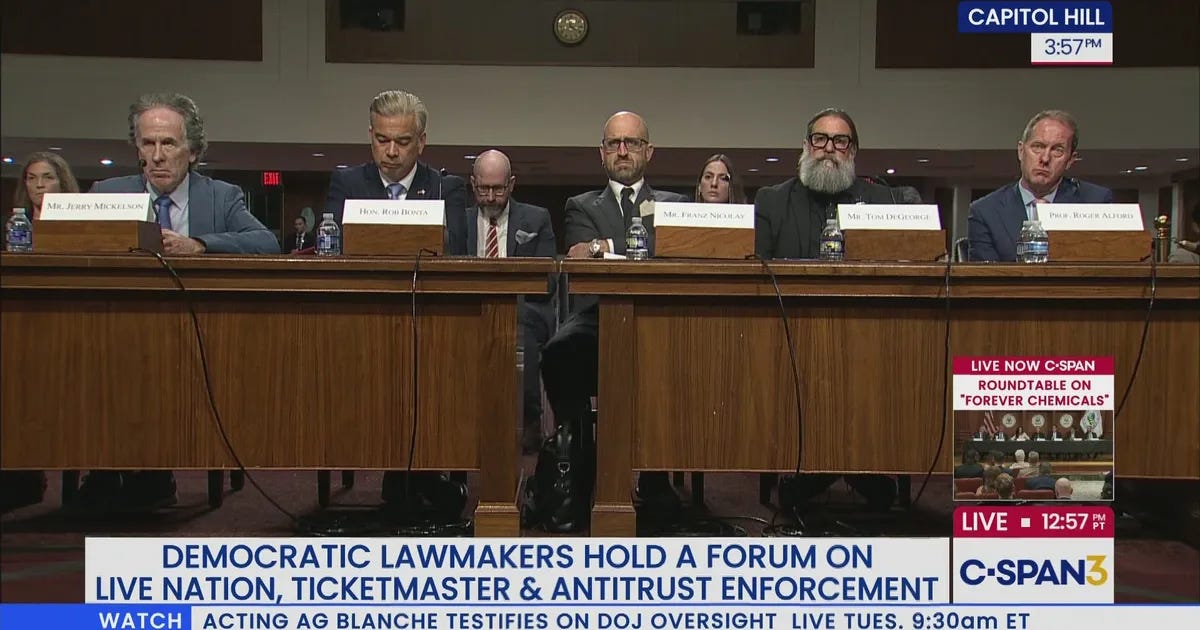
This week, a group of Democratic members of congress held a spotlight forum on the Live Nation-Ticketmaster monopoly, and the Department of Justice’s settlement of antitrust action against the company. Two members of the National Independent Venues Association (NIVA) spoke to the issue on behalf of venue owners and promoters. And Franz Nicolay of the Hold Steady testified eloquently to working artists’ view of the problem. All applauded ongoing efforts by state Attorneys General to continue antitrust actions, despite the DOJ settlement.
But another issue facing musicians emerged from Franz’s testimony, one which needs a different solution.
“I have… witnessed the shift from an industry in which live performance - touring - was a loss leader meant to promote record sales, to a contemporary one in which albums are given away, practically speaking, for free on streaming services, to promote our shows. Our business today lives and dies on ticket sales, and the merchandise we sell at those concerts. My personal income from music over the last five years, post-pandemic, has averaged about 10% from record royalties and 90% live-performance and non-album merchandise income (T-shirts, posters, and so on). For the band I spend most of my time with (though I’m speaking here as an individual, not a representative of any particular group), the divide is even starker. We aren’t in the recording business; we’re in the performance business.”
It seems that even a successful recording artist like Franz Nicolay, whose band the Hold Steady had a Top Ten Billboard album release as recently as 2021, and whose streams number in the tens of millions, cannot earn more than 10% of professional income through record royalties. If the Hold Steady is effectively no longer in the recording business, as Franz said in his testimony, who still is?
The Living Wage for Musicians Act, H.R. 5664, has been introduced to the House Judiciary Committee to address this problem. Recorded music as a profession is being eliminated by unregulated streaming music platforms, which according to the RIAA currently account for 84% of all recorded music income in the US. But that 84% doesn’t make a sustainable income for even a popular and successful artist like the Hold Steady, whose albums, as Franz put it, “are given away, practically speaking, for free on streaming services.”
To correct this, the Living Wage for Musicians Act creates a new royalty payment from streaming platforms direct to recording musicians. This would not be the first such direct royalty payment, however; recording musicians already receive direct payment from other digital distribution of their recordings thanks to acts of Congress passed in the 1990s. The Living Wage for Musicians Act uses the same mechanism, and even much of the same language as laws that Congress previously passed unanimously to create direct payment from satellite radio, internet broadcast, and so-called “non-interactive” streaming platforms like Pandora. This system is already in place, it is administered by a nonprofit, recording musicians are already registered for it, and we currently receive payments from it just as Congress designed.
Spotify, Apple Music, Amazon Music and YouTube Music do not pay into this existing system because they have set themselves up to avoid its regulation: they are “interactive” rather than “non-interactive” streaming, and thereby exempt from any direct royalty to recording musicians. This is why 84% of recorded music income doesn’t add up to a hill of beans even for a band like the Hold Steady. Imagine what it is like for those of us without Top Ten Billboard album releases, including entire genres of recorded music which do not fit the pop model: Jazz, regional musics like Tejano and Zydeco, Worship music, and so on. The Living Wage for Musicians Act closes this loophole, restoring income to all recording artists from the digital distribution of our work.
A United Musicians and Allied Workers (UMAW) petition to pass the Living Wage for Musicians Act has been signed by thousands of musicians and music workers from every corner of the country – we have sorted it by congressional district, and we are not missing a single one. Every elected official has constituents who need this bill to make streaming pay, and make recording careers sustainable again.
The City Councils of New York, Detroit, Philadelphia, Pittsburgh and Chicago have now passed resolutions calling on Congress to make the Living Wage for Musicians Act law.
We need congressional action on this fundamental problem facing recording musicians. Add your voice to make it happen.
Listening to: Happy Today by Jeff Parker ETA IVtet
Cooking: tarragon which somehow survived a New England winter
Preach it, brother.
A thousand times YES.